AI agent auditing without identity signals is just log theater
5 min read
June 11, 2026
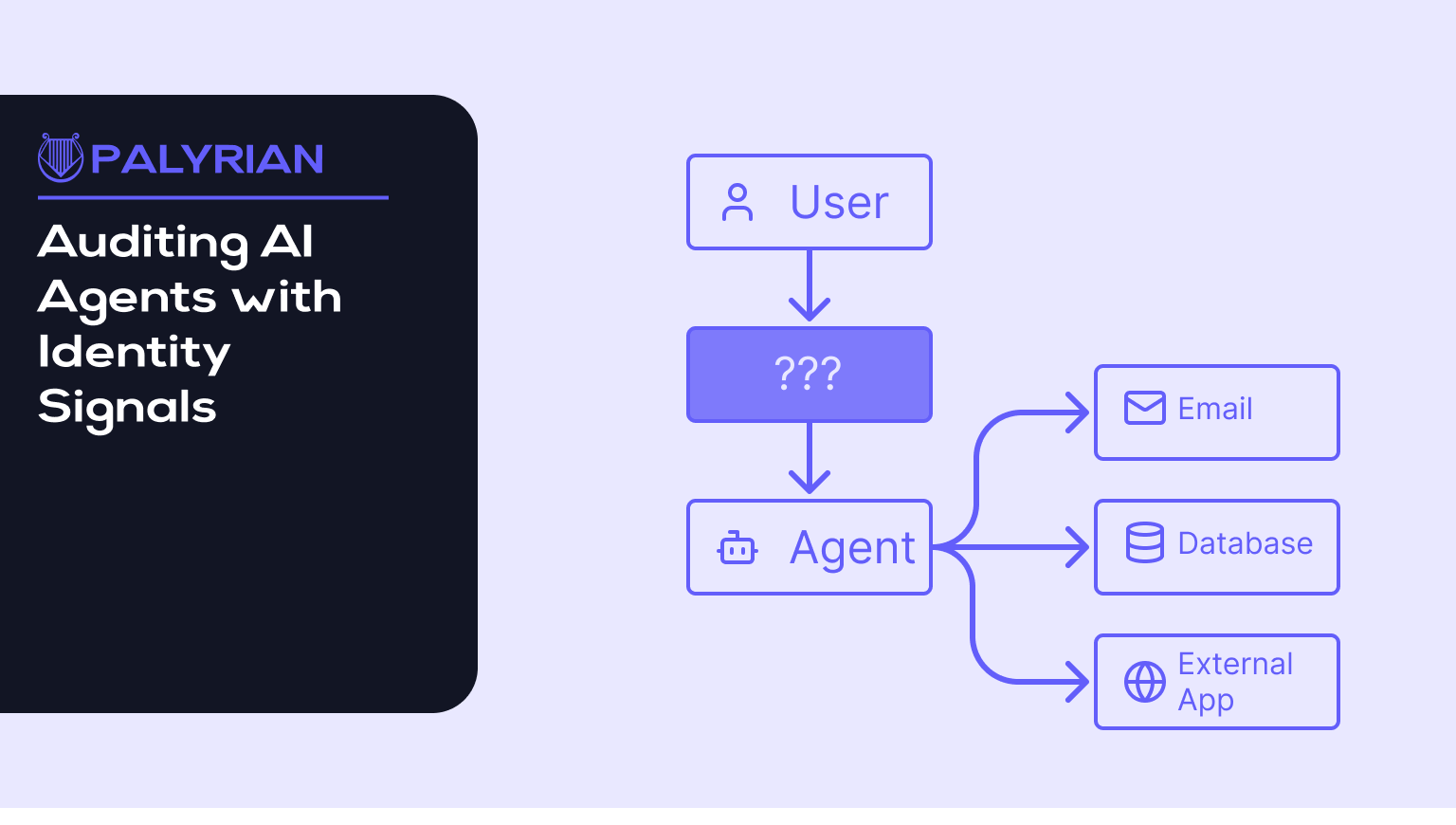
Most organizations running AI agents today have logs. What they don't have is answers.
They can tell you something happened. But they can't tell you who triggered it, whether the agent had the rights to do it, what policies were evaluated, or what spawned downstream as a result. That's not an audit trail. That's a timestamp with ambition.
This is the state of AI agent governance in 2026. And it's a problem that gets harder to ignore every time a board member, regulator, or incident response team asks a question that the logs simply cannot answer.
The first problem: You probably don't know what agents you have
Before we talk about auditing agent activity, we need to be honest about something more foundational. Most organizations don't have a clear, centralized view of what AI agents are actually running in their environment. Agents get spun up by developers, data teams, and cloud architects under the mandate to move fast and automate more. They don't go through IAM. They don't get registered anywhere meaningful. They just run.
Non-human identities now outnumber human users, with NHI-to-human ratios reaching 45:1 in average organizations and climbing to 80:1 or higher in cloud-native enterprises. Most of those identities were never formally governed to begin with.
If your identity architecture is fragmented across systems, you're not going to get visibility into your agent population from any single pane. That centralized, unified view of every agent running in your org isn't a nice-to-have. It is the foundation everything else depends on.
The second problem: Visibility is not the same as governance
Even the organizations that do have some agent visibility tend to stop there. They know the agent exists. They can see what access it has. That's where the story ends.
What's actually missing is the chain of events. Who or what invoked the agent? Was it a human or another agent? Did the invoker delegate that request, and under what context? What did the agent actually request, and was that request checked against org policies? What subagents or downstream processes spun off as a result? What was the final outcome?
Security in any agentic system eventually comes down to trust: who is making the request, what are they allowed to do, and under what specific conditions. Answering that requires identity signals captured at every handoff in the chain, not just a record that something was passed along.
What identity signals are actually required
A forensic-ready audit trail for AI agents needs to capture the full arc of every request. That means knowing who invoked it, whether it was human or machine, whether the request was delegated, whether the agent was shared or task-specific, what policies were evaluated and what decisions those gates produced, what privileges the agent held at the time of action, and what every downstream subagent was authorized to do.
IGA programs fail with NHIs for structural reasons. NHIs are rarely created through controlled workflows. They get broad privileges early because teams are optimizing for uptime, and they almost never offboard, which makes dormant NHIs with admin rights perfect compromise targets that nobody is watching.
This is why separation of duties matters so much in agentic workflows. Agents should not be able to request, approve, and execute high-risk actions within the same identity context. Separate agents for separate functions, with scoped and ephemeral credentials, is the discipline that makes auditing defensible.
What forensic-ready audits actually look like
When a regulator or a board member asks you to prove that an AI agent accessed sensitive data appropriately, you need to be able to reconstruct the full request from invocation to outcome without any gaps. That means immutable logs, unique identifiers for every human and agent in the chain, timestamps, policy evaluation records, and privilege context at the moment of action.
The best way to present that to a non-technical stakeholder is through a graph-based structure where the handoff points between agents are clearly traceable end to end. That kind of architecture doesn't emerge from standard logging pipelines. It requires identity to be a first-class citizen in how your agentic systems are designed and monitored.
Static audits are insufficient for agentic AI governance. What's required instead is continuous monitoring with real-time dashboards that flag anomalies, like an agent accessing a system it typically doesn't touch, for immediate review.
Anomaly detection for agents also needs to be tuned differently than it is for humans. Agents should be scoped to one task, one identity, time-bound credentials. When an agent starts touching multiple systems, holding long-lived credentials, or acting outside its defined scope, that's the signal. Human behavioral baselines don't apply here.
The bottom line
Log theatre feels like governance until something goes wrong. Real governance means knowing who called every agent, what it was authorized to do, and whether it stayed within those bounds. This all needs to be captured in an immutable, traceable record you can hand to anyone asking hard questions.
If you're not sure where your organization stands on any of this, that's exactly where the work starts.
Join a no-cost CTO office hour where we work through identity architecture challenges with security and engineering leaders in an open, practitioner-first format. Or start with our identity maturity assessment to get a clear picture of where your NHI and agentic governance program stands today.