Your AI risk problem is actually an identity problem
6 min read
June 4, 2026
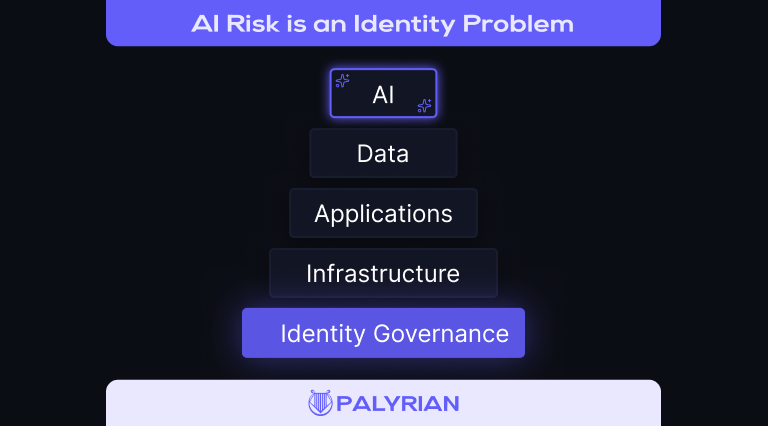
Boards are approving AI transformation roadmaps. Chief AI Officers are being added to the C-suite. Risk committees are debating responsible AI frameworks, bias audits, and model explainability standards. And meanwhile, across product, operations, finance, and HR, agents are being spun up and pulling data with permissions nobody scoped, from pipelines nobody reviewed, building outputs that nobody can fully explain.
This is the identity governance crisis hiding inside your AI strategy. And most large enterprises are completely unprepared for it.
The challenge isn't a lack of sophistication. It's a structural blind spot. The teams building AI aren't thinking about access scope. The teams managing identity aren't in the room when agents are deployed. And your current IGA architecture, designed for humans moving at human speed, has no mechanism to govern systems making decisions at machine speed. Closing that gap isn't a security project. It's a prerequisite for every responsible AI commitment your organization has made.
The speed mismatch that's already burned you
Traditional access reviews were built for human beings sitting at desks operating on quarterly cycles. That was a reasonable design when the entities requesting access were people. AI doesn't sit at a desk and it doesn't wait for a review cycle.
According to data from Oasis Security's Fortune 500 customer base, AI agent adoption surged 840 times year over year between July 2024 and July 2025, with Copilot agent creation alone growing 1,767%. By the time your access review catches a misconfigured permission, a model may have already trained on data it never should have touched.
Here's the scenario I’ve seen: an HR agent has legitimate access to performance review data for one workflow. Nobody scoped that access specifically. Nobody excluded it from a training pipeline. So it gets pulled in. The model learns from sensitive employee evaluations in a context they were never intended for. The output looks fine. The contamination is invisible.
That's what makes the identity governance gap so dangerous in AI contexts. The damage is baked in before anyone thinks to look.
Regulators are coming, and they'll start with access logs
I want to be direct about the regulatory picture because I think a lot of enterprises are miscalibrating their timeline. Yes, regulators are currently lagging on agentic AI. But that isn't a reason to wait. It's a reason to build now.
When investigators scrutinize an AI system, the first questions are always the same: what data was used, where did it come from, and who had access to it? Those are fundamental identity governance questions. And right now, most organizations can't answer them cleanly.
The numbers from IBM's 2025 Cost of a Data Breach Report are stark. 97% of organizations that experienced an AI-related security breach lacked proper AI access controls. A full 63% of breached organizations had no AI governance policy in place at all. And shadow AI, meaning AI tools deployed without IT oversight, added an average of $670,000 to breach costs. These aren't hypothetical risks. They're already materializing, and regulators are watching.
The Gartner 2025 Market Guide for Identity Governance and Administration notes that an estimated 50% of IGA deployments are currently in "distress," citing manual processes, poor data quality, and disconnected systems. Legacy IGA architectures were never built for the environment enterprises now operate in. The organizations that close this gap now won't be scrambling when regulatory scrutiny arrives.
Overprivileged agents are a business problem now, not just a security one
Here's the reality of what has changed in the last 18 months: AI isn't contained in your data science team anymore. It's in marketing, operations, finance, HR, and beyond. Business units that historically sat far from your technical infrastructure are now spinning up agents to pull customer data, automate workflows, and make decisions that carry real accountability weight.
When a marketing team deploys an agent to pull customer segments, nobody in that room is thinking about access scope or data lineage. They're thinking about campaign performance. According to the CyberArk 2025 Identity Security Landscape, 68% of organizations currently lack identity security controls for AI, and 70% of security leaders say identity silos are a root cause of organizational cybersecurity risk. Yet 75% acknowledge that their organizations are prioritizing business efficiency over robust security controls.
The IGA problem has become a business risk problem. It's spread into every corner of the enterprise, and most organizations haven't caught up to that reality.
Explainability starts at the identity layer
There's a foundational flaw in how most enterprises are approaching AI explainability. They're investing in model interpretability tools, fairness audits, and output monitoring while having zero visibility into the access graph that produced the model in the first place.
You can't explain a model outcome if you can't explain what had access to the data that shaped it. Explainability starts at the identity layer, not the model layer. AI governance starts with visibility. Organizations must maintain a current picture of every AI asset, including models, APIs, plugins, and agents, along with the data inputs and access controls associated with each deployment.
The architectural pattern that solves this is ephemeral permissions by design. Agents get scoped access for a specific task, complete it, and credentials expire. You get a complete audit trail without persistent risk. That log isn't just a compliance artifact. It's what makes genuine explainability possible because you can trace every data source an agent touched during a task and actually defend the output. Governance doesn't slow innovation. The absence of governance creates the kind of incidents that stop innovation entirely.
What "responsible AI" actually requires under audit
The question that exposes the gap between AI ambition and AI readiness is deceptively simple: how many AI agents does your organization have running right now?
If the answer is "we're not sure," then responsible AI is a brand position, not a practice.
To hold up under audit, responsible AI requires a live inventory of every agent in your environment, ephemeral permissions with no persistent agent access, access reviews that operate at the speed AI actually operates, and an audit trail that maps every agent action back to an authorized identity. Gartner's prediction that by 2028, 50% of organizations will adopt zero-trust data governance frameworks isn't a future aspiration. For enterprises operating AI systems today, it's an immediate baseline requirement.
Access transparency isn't just an audit requirement. It's a precondition for accountability. Without it, responsible AI is a claim without evidence.
The organizations building defensible identity governance around their AI systems now aren't just managing risk. They're building the infrastructure for AI they can actually trust, explain, and stand behind.
If you're ready to find out where your organization actually stands, our team works with enterprise security and identity leaders to assess AI-related access risk, identify governance gaps, and build a roadmap that holds up under regulatory scrutiny. Schedule a conversation with us to discuss what responsible AI governance looks like inside your environment, not just in theory.